How to Write a Freelance Contract: A Step-by-Step Guide for 2026
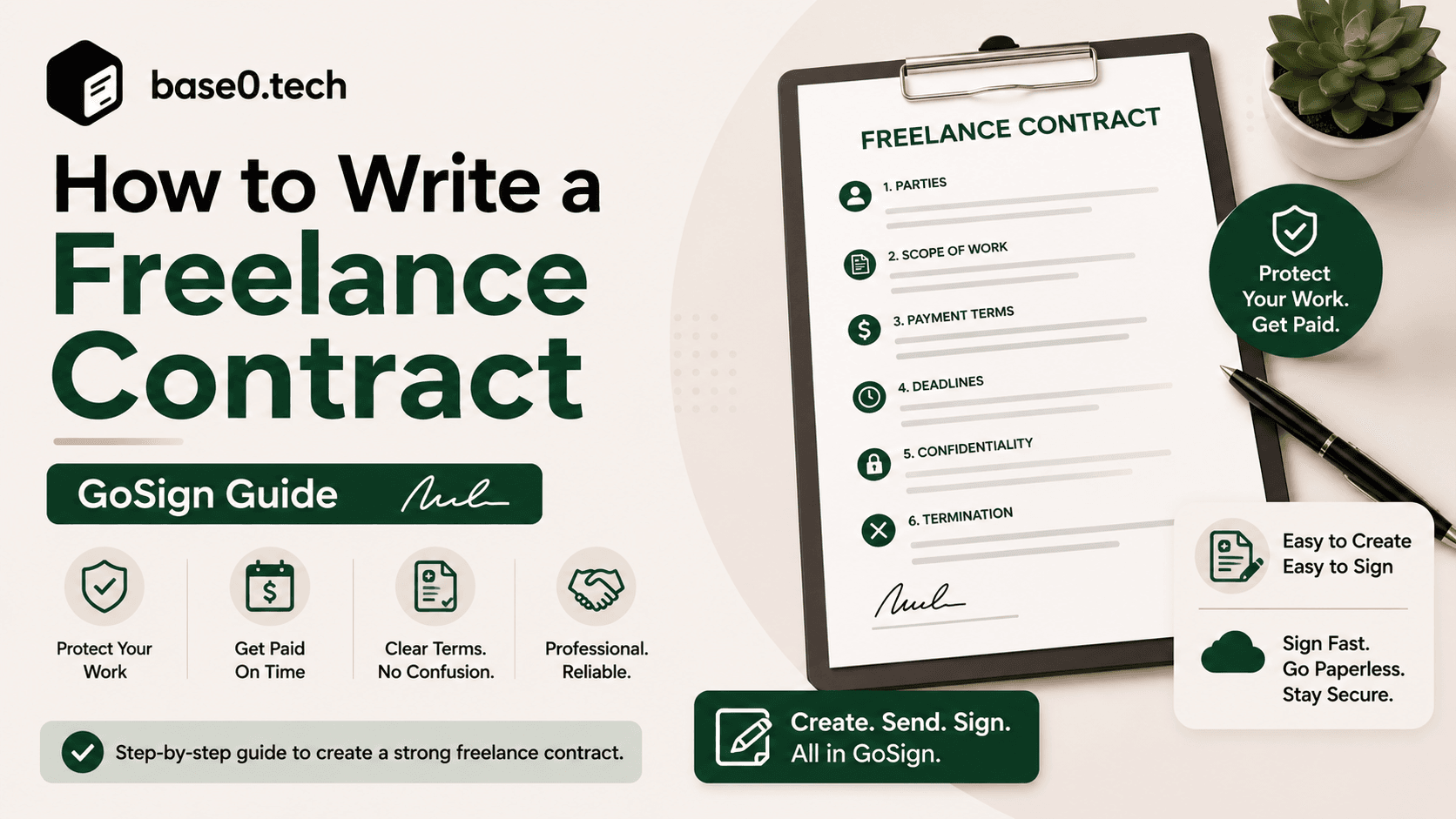
Freelancing gives you freedom — but freedom without a contract is just exposure. Whether you're a designer closing your first client deal or a copywriter juggling five retainers, a written contract is the single most important document in your business. It defines what you're doing, what you're getting paid, and what happens if things go sideways. This guide walks through every piece of a solid freelance contract, from the opening clause to the signature — and how to get it signed and paid without the process eating your week.
Why Every Freelancer Needs a Written Contract
The U.S. freelance workforce has grown past 76 million people, adding millions more every year. With that many independent workers competing for the same clients, the gap between "professional" and "amateur" often comes down to one thing: whether you show up with a contract.
A contract isn't a sign of distrust — it's a sign you take your work seriously. It sets expectations before the project starts, which means fewer surprises, fewer arguments, and fewer invoices that go unpaid.
Disputes a Contract Prevents
Most freelance disputes cluster around a few predictable issues: scope creep, late or missing payment, disagreement over how many revision rounds were included, and confusion about who owns the finished work. Surveys of freelance writers consistently find unrealistic deadlines among the top reasons freelancers turn down projects — a contract heads this off by locking in timelines before work starts.
Without something written down, you're relying on memory and goodwill. A client who remembers "unlimited revisions" when you quoted two rounds probably isn't lying — they may genuinely recall it differently. A contract removes that ambiguity, and it gives you something to point to if a disagreement escalates.
How a Contract Builds Trust
Sending a contract signals you run a real business. Clients — especially companies and agencies — expect one, and many will trust you more once they see a professional agreement, because it tells them you've done this before and know how to protect both sides.
A clear contract also cuts down the back-and-forth that slows projects down. When scope, timeline, and payment terms are locked in upfront, clients spend less time second-guessing and more time actually moving the project forward.
What to Include in a Freelance Contract
A freelance contract doesn't need to run 30 pages. Most effective ones are 2–5 pages and cover the same core ground. Here's what belongs in every freelance agreement.
Parties and Contact Information
Start with the basics: full legal names of both parties, business names if applicable, and contact details including mailing addresses. This establishes exactly who's entering the agreement, so there's no ambiguity about who owes payment or who owes delivery.
If you're contracting with a company rather than an individual, name the company as the client and note who's signing on its behalf. This matters if a dispute ever needs to be resolved formally.
Project Scope and Deliverables
This is the most important section in the whole document. Describe exactly what you'll deliver — specifically, not generally. "Website copy" is vague. "Five pages of website copy (Home, About, Services, Blog, Contact), roughly 2,500 words total, delivered as a Google Doc" is not.
List every deliverable individually. If the project has multiple phases, break them out. The more precise this section is, the harder it becomes for a client to claim you owe them something you never agreed to.
Timeline and Milestones
Set a start date, any intermediate milestones, and a final delivery date. If your timeline depends on the client supplying materials — brand assets, source files, interview access — note that your dates are contingent on receiving those by a specific point.
Milestones matter most on longer projects: they give both sides a checkpoint to confirm things are on track, and they create a natural moment to review before moving to the next phase. Tying payments to milestones (more on this below) also protects your income if a project stalls out.
Payment Terms and Schedule
State your rate clearly — flat fee, hourly, or retainer — and specify the total due. Break out the schedule: deposit due date, any interim payments, and final payment.
Include your preferred payment method and how many days a client has to pay an invoice. Net 30 is common, though many freelancers now use Net 14 or even Net 7 for smaller jobs. Whatever you pick, put it in writing.
How to Define Scope of Work Clearly
Scope creep is one of the most common — and costly — problems in freelance work. It rarely happens all at once; it's a client asking for "just one more thing," repeatedly, until you've delivered twice the work for the same fee. A tightly written scope section is your main defense.
Specific Deliverables vs. Vague Descriptions
The test: could a stranger read this line and know exactly what is and isn't included? If not, rewrite it.
Vague: "Social media content for the month"
Specific: "12 Instagram posts (static image captions only, no video scripts), 150–200 words each, delivered as a single Google Doc by the 25th of each month"
The specific version spells out format, platform, exclusions, word count, and delivery date. There's no room for "I thought you were also covering Twitter."
Handling Change Requests and Revisions
Every contract needs a revision policy: how many rounds are included, what counts as a revision versus a new request, and what additional rounds cost.
A common setup is two rounds included, extra rounds billed hourly. You can also define what a "round" actually means — one consolidated batch of feedback, not a rolling stream of individual comments.
For requests that genuinely expand scope, add a change order clause: any work outside the original scope requires a written, signed change order before it starts. This keeps you from doing extra work on the assumption the client will pay for it eventually.
Setting Payment Terms That Protect Your Income
Freelance income is notoriously inconsistent — a large share of freelancers report earning under $2,000 a month, with irregular workflow being the norm rather than the exception. Strong payment terms in your contract are one of the most direct ways to stabilize that.
Upfront Deposits and Retainers
Require a deposit before any work starts — typically 25–50% of the total fee. This does two things: it filters out clients who aren't serious, and it guarantees you're compensated for your time even if the project gets cancelled early.
For ongoing work, a monthly retainer is more reliable than repeated one-off invoices. The client pays a fixed amount each month for a defined scope or set number of hours, which gives you predictable income and cuts down on renegotiating terms every cycle.
Late Payment Penalties and Kill Fees
Include a late payment clause spelling out what happens if an invoice isn't paid on time — commonly a flat late fee plus a small monthly interest charge on the outstanding balance. Put the number in the contract so the client knows the consequence before they sign.
A kill fee protects you if a client cancels mid-project. It's usually a percentage of the remaining fee — often 25–50% — owed for work already completed and time you'd reserved for the project. Without one, a client can cancel at any point and leave you with nothing for work already done.
Invoicing Schedule and Currency
Specify when you'll send invoices and in what currency — write "USD" or "EUR" explicitly, not just "$", especially with international clients. Note who covers any currency conversion or transfer fees.
If you bill hourly, describe how you track and report time. If you bill by project, clarify whether the fee is fixed or adjustable if scope changes. Consistency here reduces disputes and speeds up payment — and a tool that ties your contract directly to an invoice, like Base0, removes a lot of this friction automatically.
Intellectual Property and Ownership Rights
IP is one of the most misunderstood parts of a freelance contract. Without a clear clause, both you and your client may have legitimate claims to the work — which is a real legal risk for both sides.
Work-for-Hire vs. License Agreements
Under U.S. copyright law, the creator owns a work by default unless ownership is explicitly transferred in writing. A work-for-hire clause transfers full ownership to the client on receipt of final payment — the standard arrangement for most client work, and what most clients expect.
Alternatively, you can license the work instead of transferring it outright — granting the client specific usage rights (say, the right to publish it on their site) while you keep the underlying copyright. This is more common in photography, illustration, and music, though some writers and designers use it too. Whatever you choose, spell it out.
Portfolio and Attribution Rights
Even after transferring full ownership, you can retain the right to show the work in your portfolio. Add a clause granting a non-exclusive right to display it as a sample of your services, unless the client needs confidentiality.
Attribution — whether your name appears on the finished work — is separate from ownership. Ghostwriting deals typically state the client can publish under their own name. If attribution matters to you, negotiate it up front and put it in writing.
Confidentiality, NDAs, and Non-Compete Clauses
Many clients will ask you to keep their business information confidential — reasonable, and usually covered by a simple clause within your main contract. Standalone NDAs and non-compete clauses deserve more scrutiny.
Writing a Simple Confidentiality Clause
A confidentiality clause within your freelance contract can be short: define what counts as confidential (business strategy, client lists, unreleased products), state you won't disclose it to third parties, and set how long that obligation lasts — typically one to three years after the project ends.
You usually don't need a separate NDA document. A well-written clause inside your main contract covers the same ground and keeps everything in one place. If a client insists on a standalone NDA, read it carefully before signing.
Red Flags in Client-Drafted NDAs
Watch for:
- Overly broad definitions of "confidential" that could sweep in public information or things you already knew beforehand
- No expiration date on the confidentiality obligation
- Non-compete language that blocks you from your entire industry, or from any competing client, for an extended period
- One-sided terms that bind only you, with nothing reciprocal from the client
- Jurisdiction clauses requiring disputes be resolved somewhere you don't operate
If you spot any of these, ask for revisions before signing. A client who won't negotiate unreasonable terms is a client worth reconsidering.
Termination, Cancellation, and Dispute Resolution
Every contract should cover what happens when things go wrong. This isn't pessimism — it's practical. Having the rules in place before a problem arises makes the problem much easier to resolve.
Termination for Cause vs. Termination for Convenience
Termination for cause lets either party end the contract if the other materially breaches it — the client doesn't pay, or you don't deliver. Include a cure period (typically 5–10 business days) giving the breaching party a chance to fix it first.
Termination for convenience lets either party end things without cause, with advance notice — typically 14–30 days. If the client terminates for convenience, your kill fee clause determines what you're owed for work already done. If you terminate, specify what you'll still deliver before winding down.
Mediation, Arbitration, and Governing Law
If a dispute can't be resolved directly, specify a process. Mediation (a neutral third party helps both sides reach agreement) is cheaper and less adversarial than litigation. Arbitration (a neutral third party issues a binding decision) is faster than court but removes your right to a jury trial.
Include a governing law clause naming the state whose laws apply — generally, the state where you're based. This determines which courts have jurisdiction if things escalate.
Freelance Contract Templates vs. Writing From Scratch
You don't need to start from a blank page. Templates give you a solid foundation, and plenty are free. The real question is knowing when a template is enough — and when it needs a lawyer's eyes on it.
When a Template Is Enough
For most standard freelance work, a well-written template that you customize with your own scope, rate, and terms is entirely sufficient. When you use one, read every clause before sending it — strip out anything that doesn't apply, and fill in the specifics (rate, deliverables, revision policy) the template leaves blank.
When to Get a Lawyer Involved
A few situations are worth the cost of professional review:
- High-value contracts, typically $10,000 or more
- The client is asking you to sign their contract instead of yours
- Unusual IP transfer terms, non-compete clauses, or indemnification language
- Regulated industries with specific legal requirements
- Clients based in a different country
A one-time review from a contracts attorney typically runs $200–$500 — often far cheaper than the cost of a problematic clause you didn't catch.
How to Send, Sign, and Store Your Freelance Contract Digitally
Once the contract is written, you need a reliable way to send it, get it signed, and keep a record. Email attachments and printed pages are slow, easy to lose, and hard to track. E-signature tools solve all three problems — and the best ones tie the signed contract directly to your invoice, so signing and getting paid aren't two disconnected steps.
Are Electronic Signatures Legally Binding?
In the U.S., electronic signatures are legally recognized under the ESIGN Act and the Uniform Electronic Transactions Act (UETA). Most other major economies have equivalent legislation. An e-signature carries the same legal weight as a handwritten one, as long as both parties consented to sign electronically and the signature can be attributed to the signer.
The key is documentation. A reliable e-signature tool generates an audit trail recording who signed, when, and from what IP address — that record is what gives an electronic signature its legal standing if a dispute ever comes up.
How to Use Base0 to Send, Sign, and Get Paid for Freelance Contracts
Base0 is built specifically for this: generating a freelance contract, getting it signed, and tracking the payment that follows — in one place, without needing a separate invoicing tool bolted on afterward.
Here's what the workflow looks like:
- Generate or upload your contract in Base0
- Add signature fields, dates, and any other fields your agreement requires
- Enter your client's email and send — no account required on their end, and they can sign from any device
- Track whether the contract has been viewed and signed, right alongside the invoice tied to it
- Save your standard freelance agreement as a reusable template so you're not rebuilding it for every new client
- Once signed, the connected invoice can move straight to payment tracking — no separate app, no manual copy-paste between tools
That last part is the piece most e-signature platforms leave out: they'll get you a signed PDF, but they won't tell you whether you've actually been paid. Base0 keeps contract and payment status in the same view, which matters most for freelancers who don't have time to reconcile two separate systems for every client.
You can create a free Base0 account and send your first contract in minutes, no credit card required.
Storing Signed Contracts Safely
Once a contract is signed, download the finalized document and its audit trail and store both somewhere secure. A simple structure works fine: organize by client name and year, keeping the signed PDF and audit trail together.
Use cloud storage with real access controls rather than relying on a local hard drive alone, and back it up regularly. Signed contracts are legal records — losing them removes your ability to enforce the terms if a dispute comes up later.
Common Freelance Contract Mistakes and How to Avoid Them
Even experienced freelancers slip up here. Most mistakes fall into two buckets: language too vague to enforce, and contracts that never get updated as the client relationship evolves.
Overly Vague Language
Vague language is the most common mistake, and it's almost always unintentional. Phrases like "reasonable turnaround time," "minor revisions," or "standard deliverables" feel clear when you write them but mean different things to different people.
The fix: replace every vague phrase with a specific one. "Reasonable turnaround time" becomes "within 5 business days of receiving client feedback." "Minor revisions" becomes "up to two rounds, defined as one consolidated set of feedback per round." Read back through your contract and ask: if a client interpreted this in the worst possible way, would I still be covered? If not, rewrite it.
Forgetting to Update Contracts for Repeat Clients
When you work with the same client repeatedly, it's tempting to skip the contract for later projects. Don't. Every new engagement should have its own signed agreement — even a short addendum referencing the original terms and specifying the new scope, timeline, and fee is enough.
Client relationships shift over time: scope expands, rates go up, the nature of the work changes. A contract that accurately reflected your arrangement two years ago may not reflect it today. Updating it for each new project keeps both sides protected and current.
FAQ
Do I need a lawyer to write a freelance contract? No — most freelancers write their own using a template as a starting point, customized with their specific deliverables, rates, and terms. That covers the majority of freelance engagements. If you're signing a high-value deal, working from a client's own contract with unusual clauses, or dealing with complex IP or non-compete terms, a one-time attorney review ($200–$500) is worth it.
Is a freelance contract legally binding without a physical signature? Yes. Electronic signatures are legally recognized in the U.S. under the ESIGN Act and UETA, and most other major economies have equivalent laws. A contract signed electronically is just as enforceable as one signed with a pen, provided both parties agreed to sign electronically and the signature can be attributed to the signer. Using a tool that generates a timestamped audit trail — like Base0 — strengthens that enforceability further.
What should I do if a client refuses to sign a contract? Don't start work without one. A client who won't sign is either unfamiliar with standard practice (worth a quick explanation of why it protects both sides) or deliberately avoiding a written commitment — which is a real warning sign. Objecting to specific clauses is a normal negotiation. Refusing any contract at all is a strong signal to walk away.
How long should a freelance contract be? Most effective ones run 2–5 pages. Completeness matters more than length — scope, payment, IP, revisions, termination, and dispute resolution all need to be covered, but not in dense legal prose. Shorter, plain-language contracts tend to actually get read by both sides. If yours is creeping past 8–10 pages for a standard project, it's probably more complicated than it needs to be.
Can I use the same contract for every client? You can reuse the same structure and base terms, but customize the project-specific sections — scope, deliverables, timeline, fee — for each engagement. Saving your contract as a reusable template (Base0 supports this) makes it fast: the standard clauses stay put, you fill in the specifics, and you send. Never send a contract with a previous client's placeholder details still in it.
What is a kill fee, and should I include one? A kill fee is a cancellation charge the client owes if they cancel a project after work has started — typically 25–50% of the remaining fee, compensating you for time already invested (and other work you may have turned down to take the project). Yes, include one. Without it, a client can cancel at any point and leave you with nothing for completed work. Kill fees are standard in professional freelance agreements, and most clients expect to see one.