How to Create a Service Level Agreement: A Step-by-Step Guide
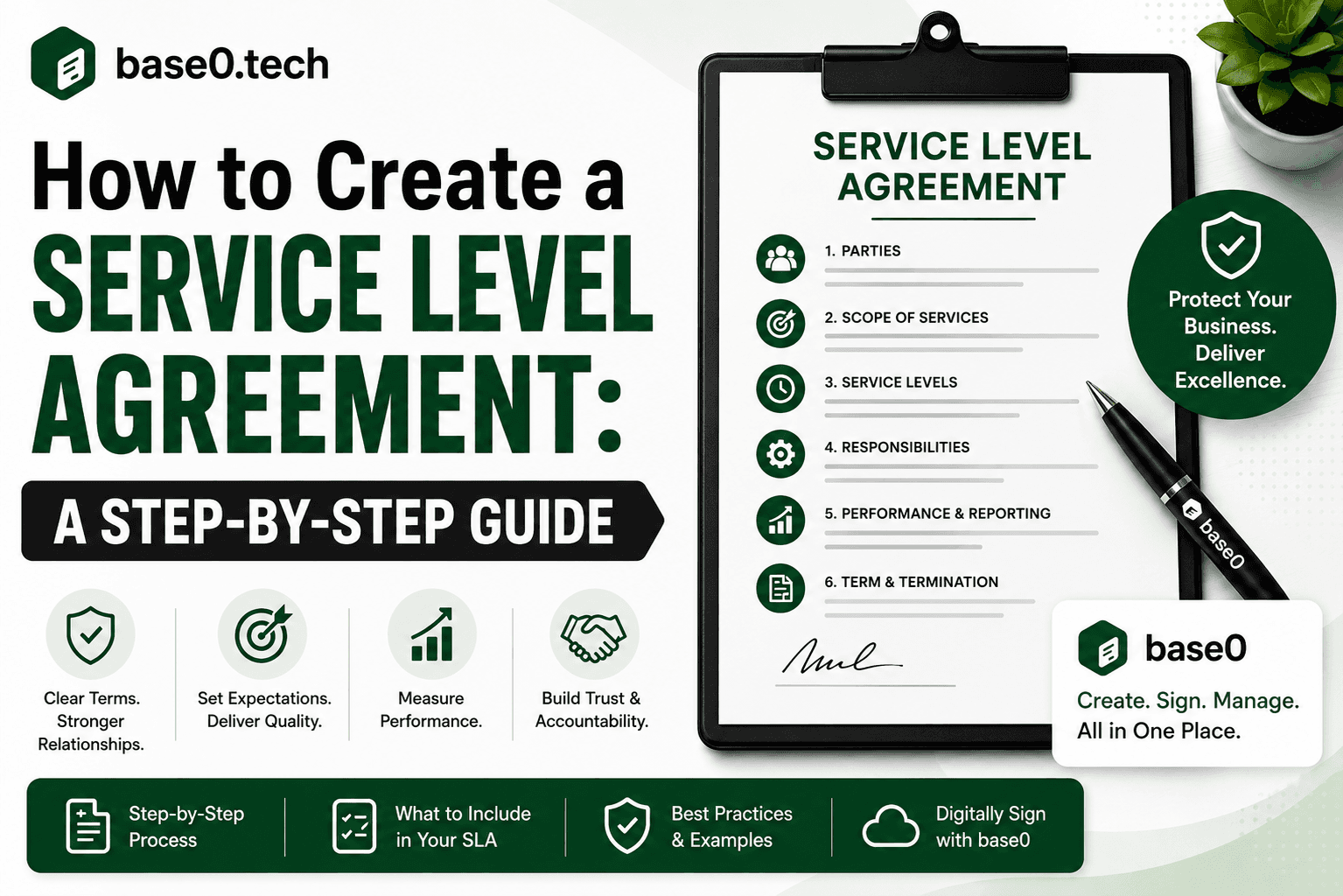
Service relationships break down when expectations aren't written down. A service level agreement (SLA) fixes that — it turns vague promises into measurable commitments, and gives both sides a shared reference point when something goes wrong.
Demand for formal service tracking has grown quickly: the SLA tracking software market moved from roughly $1.66 billion in 2024 toward $1.95 billion in 2025, a growth rate near 17.6%, driven largely by cloud adoption, remote work, and real-time compliance requirements. The signal is clear — more organizations are formalizing service expectations, and the ones that don't are falling behind.
This guide walks through building an SLA that's clear, enforceable, and ready to sign — plus how to get it signed and tracked without the process becoming its own admin burden.
What Is a Service Level Agreement, and Why Does It Matter?
A service level agreement is a formal document between a provider and a customer that spells out what service will be delivered, how performance will be measured, and what happens if those standards aren't met. It's the operational backbone of any ongoing service relationship.
SLAs matter because ambiguity is expensive. Without one, disagreements over response times, uptime, or deliverable quality turn into subjective arguments. With one, both sides agreed on the rules — including the consequences for falling short — before anything went wrong.
SLA vs. Contract: What's the Difference?
A contract establishes the legal relationship between two parties — payment terms, IP, liability, termination rights. An SLA lives inside or alongside that contract and focuses specifically on service performance. A contract answers "what are we agreeing to?" An SLA answers "how well does it need to be done, and how will we know?"
In practice, plenty of service agreements combine both into one document. But keeping the SLA as its own section — or a separate exhibit — makes it easier to update performance standards later without renegotiating the whole contract. That's also true for freelancers and agencies: if your freelance contract already covers scope, payment, and IP, an SLA-style performance section can sit alongside it rather than replace it.
Common SLA Structures
Three structures show up most often:
- Customer-based SLA — one agreement covering every service delivered to a single customer. Useful when that customer's needs differ from your standard offering.
- Service-based SLA — one agreement applying to every customer receiving the same service. Efficient for standardized offerings like hosting or managed IT support.
- Multi-level SLA — a layered structure separating corporate-level commitments, customer-level specifics, and service-level details. Common in larger organizations running multiple service lines across multiple clients.
Who Actually Needs One?
Any organization delivering or receiving ongoing services benefits from an SLA, including:
- IT and managed service providers defining uptime and support response times
- SaaS companies setting availability and incident-response expectations
- HR and operations teams formalizing internal commitments between departments
- Vendors and suppliers in manufacturing, logistics, and construction
- Freelancers and agencies setting delivery timelines and revision scope with clients
If a service relationship repeats, produces measurable outputs, or carries real financial consequences when it fails, it needs an SLA.
Core Components Every SLA Must Include
A good SLA isn't long for the sake of thoroughness — it's precise because precision prevents disputes. At minimum, every SLA needs these four sections.
Service description and scope — Defines exactly what's being provided in plain language, including what's included and what's explicitly excluded. Vague scope is the single most common source of SLA disputes.
Performance metrics and KPIs — The heart of the document. Think 99.9% uptime for critical systems, 15-minute response windows for urgent issues, or four-hour resolution caps for enterprise clients. Every metric needs to be specific, measurable, and tied to a defined measurement method.
Roles and responsibilities — Lists what the provider owes, what the customer owes, and any shared responsibilities, so nobody's stuck saying "that's not my job" mid-incident.
Penalties and remedies — Defines service credits, financial penalties, or other consequences when a target is missed, along with the escalation path: who gets contacted, in what order, within what timeframe.
Step 1 — Define the Parties and Scope of Services
Every SLA starts the same way: who is this between, and what exactly are they agreeing to?
Identifying Providers and Customers
Use legal entity names, not trade names or informal references. If subsidiaries, affiliates, or subcontractors are involved, name them here — ambiguity about who's responsible for what starts at the top of the document.
Also define the relationship type. External vendor agreement? Internal service desk commitment? Managed services contract? That framing shapes everything downstream.
Writing a Clear Scope Statement
A scope statement should answer three questions: What's covered? What does delivery actually look like? What's explicitly out of scope?
Keep it in plain language. A good scope statement is specific enough that someone unfamiliar with the relationship could read it and understand exactly what's being provided.
Compare "provide IT support" with: "Provide remote technical support for all company-owned Windows workstations during business hours (8 AM–6 PM local time, Monday–Friday), excluding hardware repair and third-party software licensing issues." The second version leaves nothing to interpretation.
Step 2 — Set Measurable Service Level Objectives
Objectives without numbers are just wishes. This step turns commitments into targets you can actually track.
Choosing the Right Metrics
Pick metrics that reflect what genuinely matters to the customer:
- Uptime/availability — the percentage of time a system is operational; 99.95% is a common benchmark for critical infrastructure
- Response time — how quickly an issue is acknowledged after it's reported
- Resolution time — how long full resolution takes after acknowledgment
- Throughput — volume of work completed in a defined period
- Error rate — the acceptable percentage of failed transactions or defective outputs
Favor metrics that are directly observable, consistently measurable, and meaningful to the customer's actual operations.
Setting Baselines and Benchmarks
Establish a baseline before committing to a target. If you've been averaging 98.5% uptime, promising 99.9% without infrastructure changes sets you up to miss. Industry references — 99.95% network availability and 15-minute response windows for urgent issues are common enterprise benchmarks — are useful starting points, not defaults you should adopt blindly.
Common Metric Pitfalls
- Measuring what's easy instead of what matters. Ticket volume is easy to count; resolution quality is harder to measure but usually more relevant.
- Setting targets without defining how they're measured. "99.9% uptime" is meaningless without agreement on how downtime is calculated, what tool monitors it, and who can see the data.
- Piling on too many metrics. A bloated SLA with 20 KPIs is harder to monitor and easier to game. Five to eight metrics that genuinely reflect service quality beat twenty that don't.
Step 3 — Outline Responsibilities, Exclusions, and Assumptions
A strong SLA defines what both parties owe, what falls outside the agreement entirely, and what conditions it assumes to be true.
Provider vs. Customer Obligations
List the provider's obligations explicitly — what, when, how. Then list the customer's — access they must grant, information they must supply, approvals they must give. Many SLA failures trace back to an unmet customer obligation that was never actually documented.
If the provider's response-time commitment assumes tickets come through a specific portal, that requirement belongs in this section.
Exclusions and Force Majeure
Exclusions protect the provider from being held accountable for things outside their control:
- Scheduled maintenance windows (with advance notice)
- Third-party outages (internet providers, cloud platforms, payment processors)
- Customer-caused incidents
- Force majeure events — natural disasters, government actions, infrastructure failures beyond reasonable control
Define force majeure specifically rather than relying on generic "acts of God" language — a concrete list of scenarios and notification requirements holds up better.
Documenting Assumptions
Assumptions are the conditions the SLA depends on: a stable customer network, 24/7 access to a production environment, continued availability of a third-party API. Write them down. Undocumented assumptions become disputes; documented ones become shared context.
Step 4 — Establish Reporting, Monitoring, and Review Processes
An SLA without a reporting structure gets filed and forgotten. This step builds the operational layer that keeps it alive.
Reporting Frequency and Format
Define how often reports are produced, by whom, and in what format. Monthly is standard for most service relationships; high-stakes or high-volume services may call for weekly reports or real-time dashboards.
Specify what each report includes: metrics tracked, measurement period, actual vs. target performance, any incidents or breaches, and a summary of remediation taken. Consistent format makes trend analysis possible over time.
Monitoring Tools and Data Sources
Agree on what tools measure performance. If the provider uses an internal monitoring platform, the customer should still have visibility — a shared dashboard or regular data export. Disputes about whether an SLA was breached usually come down to whose data you trust, so settling on the monitoring source in advance removes that argument before it starts.
Scheduled Review Meetings
Build reviews into the agreement itself. A quarterly business review (QBR) is a common cadence for managed service relationships, covering performance trends, upcoming changes, and whether the current metrics still reflect what actually matters to the customer. Without scheduled reviews, SLAs drift out of alignment — and nobody notices until something breaks.
Step 5 — Define Penalties, Credits, and Escalation Procedures
Consequences give an SLA its teeth. Without them, a missed target is just a data point.
Service Credits and Financial Penalties
Service credits are the most common remedy, typically a percentage of the monthly or annual fee scaled to breach severity. For example:
- Uptime between 99.0%–99.5%: 10% service credit
- Uptime between 98.0%–99.0%: 25% service credit
- Uptime below 98.0%: 50% service credit
Define the calculation method, a credit cap (often 30–50% of monthly fees), and the claims process. State clearly whether credits are the sole remedy or whether the customer can also pursue additional damages.
Escalation Tiers
A typical three-tier escalation structure:
- Tier 1 — front-line support: initial response and standard resolution
- Tier 2 — senior technical staff or account manager: escalated after a defined period without resolution
- Tier 3 — executive or vendor leadership: escalated for critical or unresolved breaches
Each tier needs a defined response time and a named role — not just a job title, but an actual contact method.
Dispute Resolution
When both parties disagree about whether the SLA was breached, you need a defined process: informal negotiation first, then mediation, then arbitration or litigation if necessary. Specify governing law, jurisdiction, and a timeline for each step so disputes don't drag on indefinitely.
Step 6 — Review, Finalize, and Sign Your SLA Digitally
A well-drafted SLA is only as good as the process used to finalize and execute it.
Legal Review Checklist Before Signing
- Are all parties named with their correct legal entity names?
- Is the service scope specific enough to prevent interpretation disputes?
- Are all metrics tied to a defined measurement method, not just a target number?
- Are exclusions and force majeure provisions clearly stated?
- Are penalty calculations unambiguous and appropriately capped?
- Is governing law and jurisdiction specified?
- Does the agreement include term, renewal, and termination clauses?
- Has someone outside the relationship reviewed the final draft?
If you're not using legal counsel, at minimum have someone unfamiliar with the relationship read it and flag anything unclear.
How to Sign an SLA Electronically with Base0
Once your SLA is finalized as a PDF, Base0 handles the signing without the friction of print-sign-scan. Upload the document, add signature and date fields for each party, set the signing order if more than one signer is involved, and send. Each recipient gets a secure signing link by email and can sign from any device — no account required on their end.
If you send SLAs regularly — say, as part of onboarding every new managed services client — save the field layout as a reusable template so you're not rebuilding it each time. And because Base0 was built around the whole contract-to-payment lifecycle rather than signatures alone, an SLA tied to a recurring service fee can sit in the same view as the invoicing and payment status for that client, instead of living in a signature tool that has no idea whether you've actually been paid. That's the same idea covered in more detail in our guide to writing and signing freelance contracts.
Storing and Managing Signed SLAs Securely
After signing, download the finalized document and its audit trail — timestamps, signing activity, a record of who signed and from where — and store both somewhere secure and organized. Real-time status tracking (sent, viewed, signed, declined) means you always know exactly where a pending SLA stands without chasing anyone by email.
Common SLA Mistakes to Avoid
Vague or unmeasurable metrics. "High availability" and "fast response times" aren't SLA metrics — if a target can't be measured objectively, it can't be enforced. Every commitment needs a specific number, a defined measurement method, and an agreed data source.
Ignoring change management. Services evolve — scope expands, technology shifts, business needs change. An SLA without a formal process for proposing, reviewing, and approving changes goes stale fast, and stale SLAs create gaps nobody anticipated.
Failing to update it regularly. An SLA reflects the priorities of the moment it was written. A year later, those priorities may look very different. Build a periodic review requirement — typically annual, or triggered by a significant change — directly into the document. An SLA that hasn't been touched in two years is a liability, not a safeguard.
What a Solid SLA Template Should Include
A template gives you a starting point instead of a blank page. A good one covers:
- Party identification and agreement date
- Service description and scope statement
- Performance metrics table with targets and measurement methods
- Provider and customer obligations
- Exclusions and force majeure clause
- Reporting and review schedule
- Service credit and penalty structure
- Escalation matrix
- Dispute resolution clause
- Term, renewal, and termination provisions
- Signature block for all parties
To customize it: fill in party names and the service description first, then work through the metrics section, replacing placeholder targets with numbers based on your actual baseline performance and customer expectations. Review the exclusions list for anything specific to your service environment, and adjust credit percentages to reflect the real financial stakes involved.
Get Your SLA Signed with Base0
Once your SLA is ready, Base0 gets it signed without adding another tool to your stack. Generate or upload your document, place signature fields, set the signing order, and send — free to start, no credit card required. Reusable templates mean you're not reconfiguring the same fields every time you onboard a new client or vendor, and because contracts and payment tracking live in the same place, you're not stuck cross-referencing a separate invoicing tool to see whether a service fee tied to the SLA has actually been paid.
Create a free Base0 account and send your first SLA today — and if you're setting this up alongside a client contract, our guide on how to write a freelance contract covers the parts an SLA doesn't, like payment terms, IP ownership, and kill fees.
FAQ
How long does it take to create a service level agreement? A straightforward SLA between two parties with a well-defined scope can be drafted in a few hours using a template. More complex agreements — multiple service lines, multiple parties, technical performance metrics — can take several days to draft, review, and negotiate. Budget extra time for legal review if the agreement carries significant financial consequences.
Is a service level agreement legally binding? An SLA can be legally binding when it meets the standard requirements of a contract: offer, acceptance, consideration, and mutual intent to be bound. Most SLAs are either standalone contracts or exhibits to a master services agreement, both enforceable when properly executed. Enforceability still depends on the specific language, jurisdiction, and how it was signed — consult a qualified legal professional for advice specific to your situation.
Can I create an SLA without a lawyer? Yes, for straightforward service relationships with lower financial stakes. A well-structured template plus careful attention to specificity in metrics, exclusions, and remedies can produce a genuinely functional agreement. For high-value contracts, complex service environments, or relationships crossing jurisdictions, legal review is worth it — a poorly drafted SLA can be harder to enforce than no SLA at all.
What's the difference between an SLA and an SOW? A statement of work (SOW) defines specific deliverables, timeline, and tasks for a project — typically for one-time or project-based engagements. An SLA defines ongoing service performance standards for a continuing relationship. An SOW answers "what will be built and when?" An SLA answers "how well will the service be delivered, and what happens if it isn't?" Many relationships use both: an SOW for the initial project, an SLA for the ongoing support that follows.
Can a service level agreement be signed electronically? Yes. Electronic signatures are widely accepted for commercial agreements in most jurisdictions. With Base0, you upload your finalized SLA as a PDF, add signature and date fields for each party, set a sequential signing order, and send — free to start. Every signed document comes with an audit trail including timestamps and signing activity, giving you a clear record of the execution process.
How often should an SLA be reviewed and updated? At least annually, and any time something significant changes — a new service is added, the customer's business needs shift, or the provider's infrastructure changes materially. Building a review schedule directly into the SLA (an annual review meeting, for instance) keeps it from getting overlooked. An SLA untouched for two or more years is likely out of alignment with the actual service relationship, which creates risk for both sides.