How to Send a Proposal to a Client: A Step-by-Step Guide That Wins Business
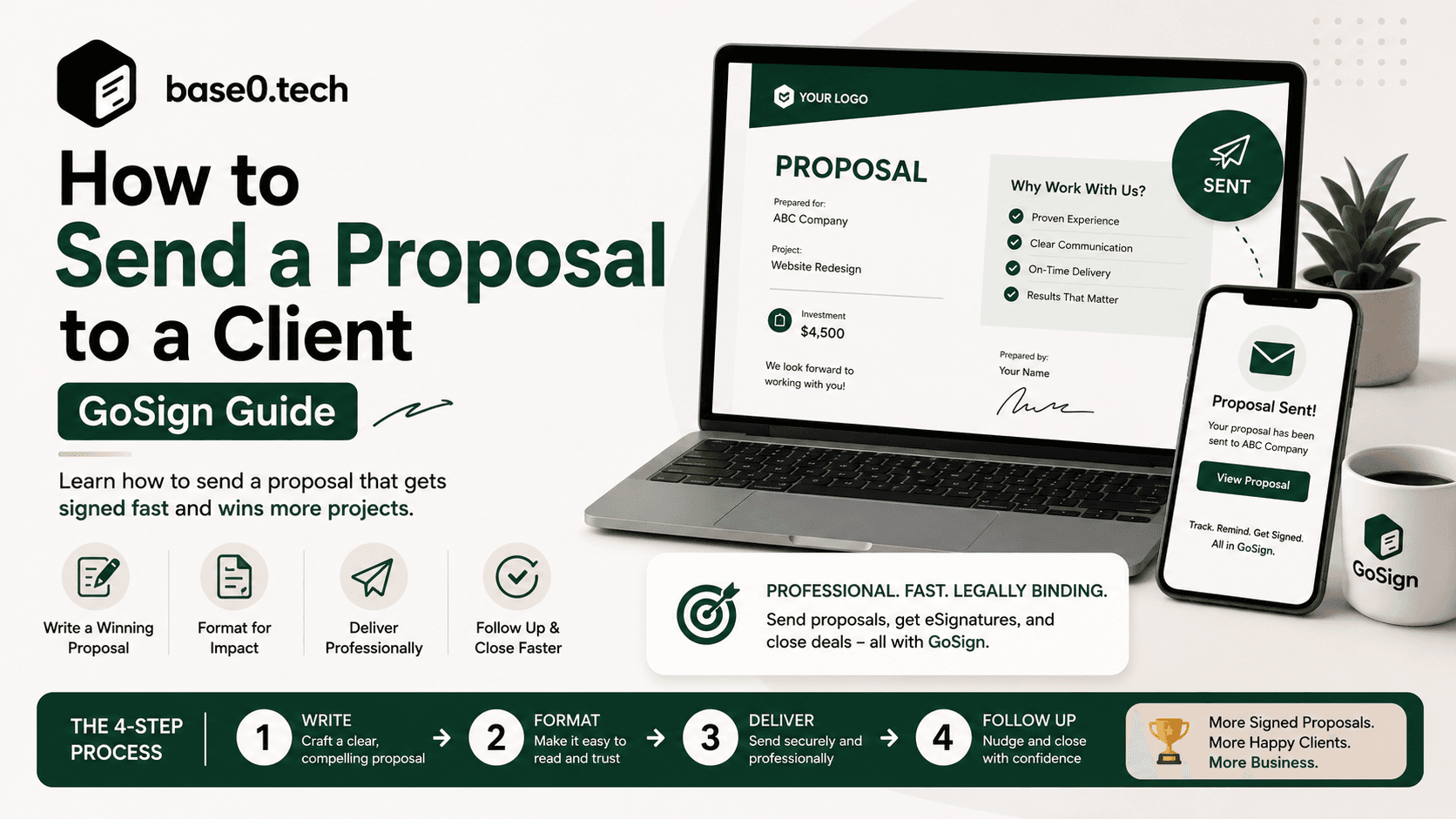
Sending a proposal to a client is one of the highest-leverage moments in any business relationship. Done well, it signals professionalism, builds trust, and moves a deal forward. Done poorly, it gets ignored — or worse, it actively costs you the work. This guide covers every stage: what to include, how to write it, how to deliver it, and how to follow up without being annoying.
What Is a Client Proposal, and Why It Matters
A client proposal is a formal document outlining how you plan to solve a client's problem, what it will cost, and what they can expect from working with you. It's not a contract yet — but it's the document that determines whether a contract ever gets signed.
Proposals matter because they're often the first detailed look a client gets at how you think. A well-structured proposal shows you understand their situation, have a clear plan, and deliver on commitments. A weak one — generic, vague, or poorly formatted — signals the opposite before the work has even started.
Proposal vs. Quote: What's the Difference?
A quote is a price. A proposal is an argument. Quotes tell a client what something costs. Proposals tell a client why they should hire you, what you'll do, how you'll do it, and what it will cost — in that order.
Quotes work when scope is already agreed and the client just needs a number. Proposals work when the client has a problem and needs convincing that your approach is the right one. Most service businesses, agencies, consultants, and freelancers need proposals rather than quotes, because scope is rarely obvious upfront.
How a Strong Proposal Sets the Tone
How you write and deliver a proposal tells a client a lot about what it's like to work with you. Clear, organized, and tailored signals that you listen and respect their time. Rushed, generic, or jargon-heavy signals the opposite — and clients spot a one-size-fits-all template almost instantly. The proposal is your first real deliverable. Treat it that way.
Types of Client Proposals
Not every proposal is the same. Knowing which type fits your situation helps you calibrate formality, length, and detail before you write a word.
Solicited vs. Unsolicited
A solicited proposal is one the client asked for — a formal RFP or a direct request after a conversation. There's a clear brief to respond to, which makes it easier to write but often more competitive, since other vendors are likely responding too.
An unsolicited proposal is sent without being asked. It takes more upfront work, since you need to establish the problem before proposing a solution. These can be highly effective when you've identified a genuine gap in a prospect's business — but they need to be tightly written, since the client has no existing frame of reference.
Project-Based, Retainer, and Partnership Proposals
Project-based proposals cover a defined scope with a clear start and end date — common in construction, web development, marketing campaigns, and consulting. Scope, deliverables, and price are fixed to a specific outcome.
Retainer proposals establish an ongoing relationship with a recurring fee for continued access to your services. These need to clearly define what's included, what falls outside it, and how the relationship gets managed over time.
Partnership proposals are less transactional, more strategic — a longer-term collaboration, joint venture, or referral arrangement. These need a strong section on mutual benefit and shared goals.
Formal vs. Informal Formats
Formal proposals follow a structured format — cover page, executive summary, problem statement, solution, scope, pricing, terms, signature block. Appropriate for larger engagements, enterprise clients, and RFP responses.
Informal proposals are shorter and more conversational — a well-written email with a clear scope and price attached as a PDF works fine for smaller freelance projects or repeat clients. Match the format to the relationship, not the other way around.
What to Include in a Winning Client Proposal
Each section moves the client from "interested" to "ready to sign." Here's what belongs in every strong proposal.
An Executive Summary That Hooks
This is the most important section — and the one most people write last and treat as an afterthought. Decision-makers often read only the executive summary before deciding whether to pass it along or move forward.
A strong executive summary isn't a table of contents. It's a concise statement of the client's situation, the core problem you're solving, and the outcome you're promising — written in plain language, focused entirely on the client, free of jargon, and kept to one page or less.
Problem Statement and Proposed Solution
Before pitching your solution, demonstrate you understand the problem. A clear problem statement shows the client you've listened and grasped the real issue, not just the surface-level request.
The proposed solution follows directly: your approach, why it's right, and what makes it different. This section should speak to the client's specific goals and priorities, not just describe your standard offering.
Scope of Work and Deliverables
This is where you get specific. List exactly what you'll deliver, what's included, and — critically — what isn't. Vague scope is one of the most common sources of client disputes and project overruns. (Our guide on how to define scope clearly in a freelance contract covers the same principle in more depth if you're formalizing this later.)
Use bullet points to keep deliverables scannable. Specify formats, quantities, revision rounds, and any dependencies on the client's side.
Pricing, Timeline, and Terms
Vague pricing and hidden costs create distrust and kill deals. Present pricing clearly, with line-item breakdowns where appropriate. Name any contingencies or potential additional costs explicitly rather than burying them in fine print.
Include a timeline with key milestones and delivery dates, paired with payment terms — deposit requirements, milestone payments, or net terms — so there are no surprises after the proposal is accepted.
Social Proof: Case Studies and Testimonials
A proposal is a promise. Social proof is evidence you've kept similar promises before. Include one or two brief, relevant case studies or a short testimonial from a comparable client. One highly relevant example beats five generic ones.
A Clear Call to Action
Every proposal needs an explicit next step. "Let me know if you have questions" leaves the client without direction. "Please sign below to confirm, and we'll schedule a kickoff call within 48 hours" gives them a clear path. Make it easy to say yes.
How to Write a Client Proposal, Step by Step
Step 1: Research the Client's Needs
Before opening a document, understand the client's situation — their website, recent news, job postings, any RFP or brief they've shared. Review discovery-call notes carefully. The most common reason proposals fail is that they're generic; research is what separates a tailored proposal from a template with a name swapped in.
Step 2: Tailor the Proposal to the Opportunity
Use what you learned in Step 1 to customize every section. Reference the client's specific goals, use their language, and address the particular constraints they mentioned. Personalization matters more than ever now that generic, AI-generated proposals are easy to spot — and easy to reject.
Step 3: Write the Executive Summary First
Write this before the rest of the proposal, not after. It forces you to clarify your core argument before diving into details. If you can't summarize the client's problem and your solution in one page, you don't yet have a clear enough picture of what you're proposing. Write it entirely from the client's perspective — save credentials for the social proof section.
Step 4: Define Scope Clearly
Write the scope section assuming the client will hold you to every word. Be specific about what's included, what's not, and what happens if scope changes. Define ambiguous terms — what counts as a "revision," what "launch-ready" means. Misaligned expectations are a leading cause of project disputes, and a clear scope section protects both sides before work begins.
Step 5: Set Transparent Pricing
Present pricing after the solution and scope sections, not before — the client needs to understand the value before seeing the number. Break pricing into line items where it makes sense, and include payment terms (deposit percentage, milestone schedule, or net terms) along with any late payment policy.
Step 6: Proofread and Polish
A proposal with typos, inconsistent formatting, or the wrong client name signals carelessness. Read it aloud, check every number, and confirm the client's name and company are spelled correctly throughout. Build a buffer into your timeline so you have time to review — not just time to finish writing.
Formatting and Design for Maximum Impact
Choosing the Right Length
Most proposals fall between 5 and 15 pages, depending on complexity. Shorter is almost always better — every page that doesn't add value dilutes the ones that do. For small freelance projects, two to four pages is often plenty; even longer enterprise documents should have an executive summary a decision-maker can grasp without reading every section.
Branding: Logos, Colors, Fonts
Your proposal reflects your brand. Use your logo, brand colors, and consistent typography. You don't need a design team — a clean, consistent layout with your brand colors and a well-chosen font is enough to look intentional and professional.
Using Tables, Charts, and Visuals
A well-placed timeline graphic or pricing table makes a proposal significantly easier to evaluate. A cluttered layout with too many graphics makes it harder. Visuals should serve the content, not decorate it.
PDF vs. Interactive Digital Proposal
A PDF is the standard format — universally readable, format-preserving, and easy to sign electronically. For most freelancers, agencies, and service businesses, a well-designed PDF sent through an e-signature platform is the right choice. Interactive web-based proposals with embedded video and real-time tracking can work for larger deals, but they take more production effort and aren't always the right fit. When in doubt, a clean PDF with a clear signature block is the safer bet.
Delivery Methods Compared
Sending Proposals by Email
Email is the most common method and works well when done right. Attach the proposal as a PDF rather than pasting it into the body. Keep the email itself brief — three to five sentences is usually enough. The proposal does the heavy lifting; the email just needs to get the client to open it.
Using an E-Signature Platform Like Base0
Sending a proposal as a plain PDF attachment creates friction at the exact moment it matters most: when the client is ready to sign. They have to print it, sign it, scan it, and email it back — or figure out a digital workaround. That friction costs time, and sometimes costs you the deal.
Base0 removes that friction. Upload your proposal PDF, add a signature field, and send it directly to the client. They get a link, review the document, and sign in seconds from any device. You're notified the moment they sign, and both sides get a copy with a full audit trail and timestamps — and because Base0 was built for the whole proposal-to-payment lifecycle, once a signed proposal turns into an invoice, that invoice and its payment status live in the same place instead of a separate tool. It's the same connected workflow covered in our guide to writing and signing freelance contracts.
In-Person or Video Walkthroughs
For larger or more complex deals, walking the client through the proposal on a call can meaningfully increase your close rate — real-time questions, emphasis on the most important sections, and a read on their reaction before they go quiet. Send the proposal ahead of the meeting so they can review it, but don't assume they've actually read it. End the call with a clear next step: ideally a commitment to sign, or a specific response date.
Tracking Whether a Client Has Opened Your Proposal
Knowing whether a client has opened your proposal changes how you follow up. If they haven't, your follow-up should focus on confirming receipt. If they've opened it multiple times, they're likely evaluating it seriously, and your follow-up should focus on answering questions and moving toward a decision. Real-time status tracking — sent, viewed, signed, or declined — gives you that context instead of leaving you to guess.
Writing the Perfect Proposal Email
Subject Lines That Get Opened
Avoid vague subject lines like "Proposal" or "Following up." Reference the client's name, company, or specific project:
- [Client Name] — Proposal for [Project Name]
- Your [Goal] Proposal from [Your Company]
- Proposal: [Specific Outcome] for [Client Company]
- [Project Name] — Ready for Your Review
What to Write in the Email Body
Three to five sentences. Open with a direct reference to your conversation. Summarize the core outcome in one sentence. Tell them what's attached and what you want them to do next. Don't summarize the entire proposal or repeat the pricing — the email's job is to get the attachment opened, not replace it.
A Template You Can Adapt
Subject: [Client Name] — Proposal for [Project Name]
Hi [Client Name],
Thank you for walking me through your situation last week. As discussed, I've put together a proposal outlining how we can [specific outcome].
You'll find the full proposal attached, including scope, timeline, and pricing. Please review at your convenience — happy to answer questions on a quick call.
To move forward, simply sign using the link below. I'll follow up on [specific date] if I haven't heard back.
Looking forward to working together.
[Your Name]
How to Follow Up Without Being Pushy
Most proposals don't get signed on the first read. Following up isn't optional — it's part of the process. The key is following up in a way that adds value rather than just pressure.
When to Send the First Follow-Up
Two to three business days after sending, unless you agreed on a specific review timeline. If the client is reviewing proposals by a certain date, follow up one day before that deadline. Most proposals fail not because of pricing, but because of poor follow-up — a timely, professional check-in signals you're organized, not desperate.
Follow-Up Templates by Stage
First follow-up (2–3 days): "Hi [Client Name], wanted to make sure the proposal came through clearly. Happy to answer questions or jump on a quick call to walk through it together."
Second follow-up (5–7 days): "Hi [Client Name], just checking in on the proposal I sent over. I know things get busy — if timing has shifted or you have questions about scope or pricing, happy to adjust."
Final follow-up (10–14 days): "Hi [Client Name], I want to respect your time, so this will be my last follow-up. If timing isn't right or you've gone another direction, no problem — just let me know. If you're still interested, happy to reconnect."
How Many Times Should You Follow Up?
Three is a reasonable standard. The first confirms receipt and invites questions. The second checks in and offers flexibility. The third closes the loop professionally without burning the relationship. Beyond three, you risk wasting your own time — if there's no response after three attempts, the timing's wrong, the budget isn't there, or they've gone elsewhere.
Using Engagement Data to Time Follow-Ups
Timing follow-ups based on actual engagement beats following up on a fixed schedule. If a client opened your proposal three times in one day, that's a strong signal they're actively evaluating it — and a follow-up call that afternoon is likely to land well. Status tracking that shows exactly when a document was viewed removes the guesswork.
Common Proposal Mistakes That Cost You the Deal
Sending something generic. Clients spot a template instantly — wrong company name, irrelevant case studies, boilerplate language. Fix: spend more time on research before writing, and customize every section. Even small personalizations make a real difference.
Unclear pricing or hidden costs. Clients who aren't sure what's included or how billing works will hesitate to sign, and may pick a competitor with clearer pricing even at a higher rate. Be transparent, break pricing into line items, and name contingencies explicitly.
Missing a strong call to action. No clear next step means the client defaults to doing nothing, and the deal stalls. End every proposal with a specific, easy action.
Waiting too long to send it. Late submissions signal unreliability and give competitors a head start. If you need more time, say so proactively with a specific delivery date — don't go silent.
How Base0 Makes Sending Client Proposals Faster
Writing a great proposal is the hard part. Getting it signed shouldn't be. Base0 closes the gap between "proposal sent" and "deal closed" with a simple way to send, track, and collect signatures — and keep the resulting invoice in the same place once the deal is won.
Reusable templates — If you send similar proposals regularly (retainer agreements, project scopes, service contracts), save the structure and pre-configured signature fields so you're not rebuilding the same document every time. Load the template, customize the relevant sections, and send in minutes.
Send, track, and sign in one place — Upload your proposal as a PDF, add signature fields, and send. Clients get a secure link, review, and sign electronically — no printing, no scanning, no back-and-forth. Real-time status tracking shows sent, viewed, signed, or declined, so you can follow up with context instead of guessing. Every signed document includes a full audit trail with timestamps.
Automated reminders — One of the most common reasons proposals go unsigned is simply that the client forgot. Automated reminders nudge recipients who haven't completed signing, so you're not manually tracking every open proposal. Expiration controls create a natural deadline without requiring a manual follow-up every few days.
From signed proposal to paid invoice — Once a proposal is signed, the next question is always "when do I get paid?" Because Base0 connects contract and payment status in one view, that signed proposal can flow straight into an invoice you're actually tracking — rather than switching to a separate billing tool to find out where things stand.
If you're currently sending proposals as email attachments and chasing clients for signatures, Base0 gives you a faster, more professional alternative — free to start, no credit card required.
FAQ
How long should a client proposal be? Most fall between 5 and 15 pages, depending on complexity. Two to four pages is often enough for small freelance projects; longer enterprise or RFP responses should still have an executive summary a decision-maker can grasp without reading everything. Shorter is generally better — every page that doesn't add value dilutes the ones that do.
How soon should I send a proposal after meeting a client? Within 24 to 48 hours of the discovery call, while the conversation is still fresh. Waiting longer gives competitors time to get in front of your client and signals disorganization. If you need more time, say so proactively with a specific delivery date rather than going silent.
Should I send a proposal as a PDF or use an online platform? A PDF is the standard format and works fine for most situations — but a plain email attachment creates friction right at the signing stage. An e-signature platform like Base0 solves that: upload your PDF, add a signature field, and send a secure link. The client signs in seconds, you're notified immediately, and both sides get a copy with a full audit trail.
What's the best way to present pricing in a client proposal? After the solution and scope sections, not before — the client needs to understand the value before seeing the number. Use line-item breakdowns where it helps, and name any potential additional costs explicitly. Vague pricing and hidden costs create distrust and kill deals; transparency is always the better approach.
How do I get a client to sign a proposal quickly? Make signing effortless. An e-signature platform lets the client sign with one click from any device — no printing, no scanning. End the proposal with a clear call to action, set an expiration date to create a natural deadline, and use automated reminders so you're not manually chasing every open proposal. The less friction between "received" and "signed," the faster deals close.
Can I use a proposal template, or should I write from scratch every time? Templates are a smart starting point but need customizing for every client. A template gives you consistent structure and format, which saves time — the danger is treating it as a finished product rather than a starting point. Clients spot generic proposals immediately. Use a template for structure, then tailor the problem statement, solution, case studies, and pricing to the specific opportunity. Reusable templates in Base0 handle the structure and signature fields, so you're only customizing content each time.