How to Close Deals Faster: Proven Strategies for Small Business Sales in 2026
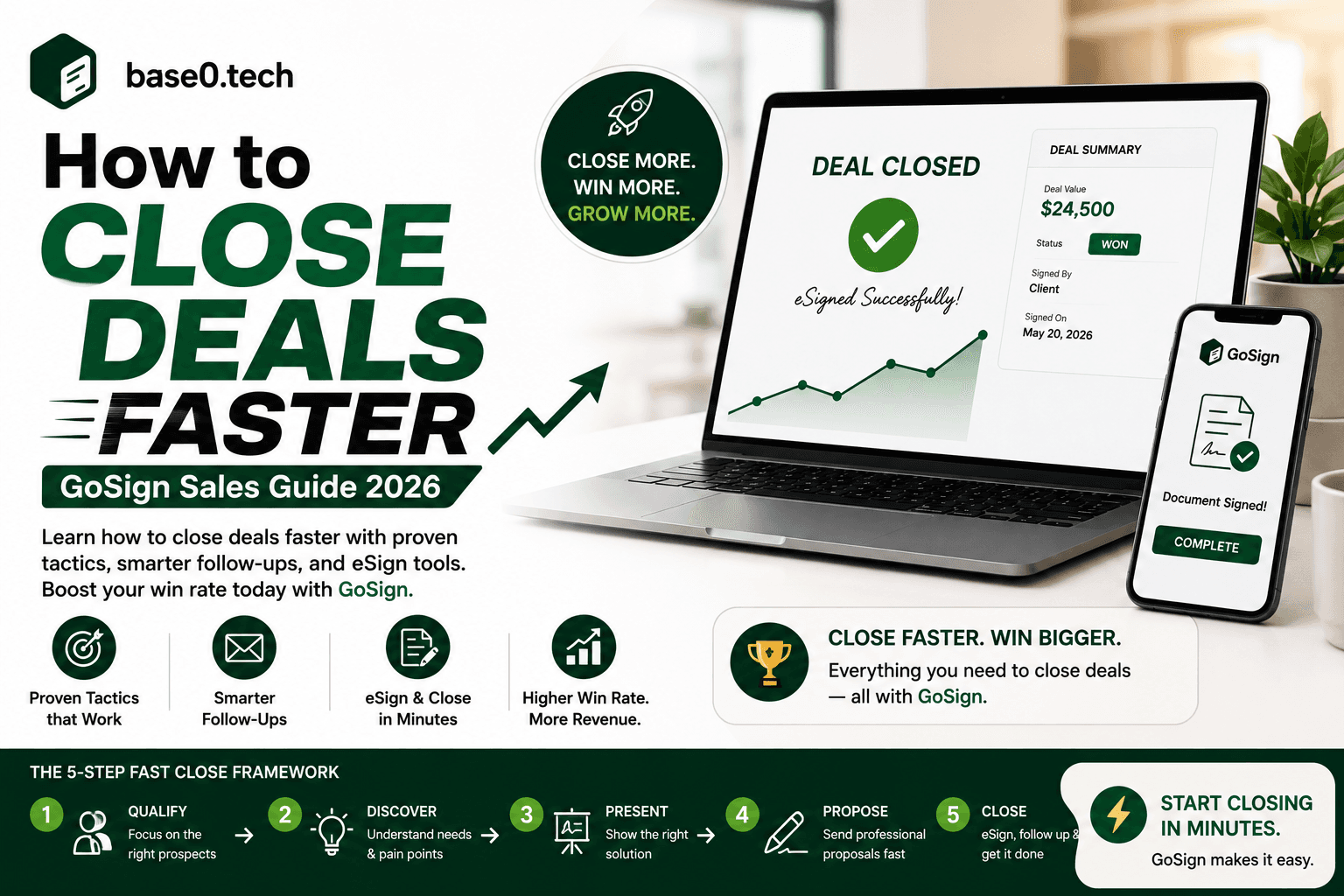
Closing deals faster isn't about pressure tactics or slashing prices. It's about removing friction at every stage of the sales process — from the first qualifying call to the moment a contract gets signed. This guide gives you a practical framework for compressing your sales cycle without compromising deal quality, whether you're a solo freelancer chasing your next client or a small team running a lean sales process.
Why Deals Stall — and What It Costs You
The Hidden Cost of a Lengthy Sales Cycle
Every day a deal sits open, it costs you money. There's the obvious cost — your time, your outreach effort, the hours sunk into proposals and follow-ups. But there's a subtler one too: the longer a deal drags on, the more likely your prospect loses interest, gets distracted by a competitor, or has their budget reallocated elsewhere. Large enterprise deals can average close to 270 days to close — nine months of pipeline risk and compounding uncertainty. For smaller deals the math looks different, but the principle holds: time kills deals.
That cost compounds across your whole pipeline. If you're carrying a handful of open opportunities and each one runs 30 days longer than it needs to, that delay shows up directly in your monthly or quarterly revenue. Cycle length isn't just an operational detail — it's a revenue metric.
Common Reasons Prospects Go Cold
Prospects don't go cold randomly — there are predictable patterns. Deals stall over unclear next steps after a call, a proposal that takes too long to arrive, a contract that requires endless back-and-forth revisions, or a champion inside the prospect's organization losing internal support. Each of these is a process failure, not a prospect failure.
Slow response time is another major culprit. Leads are dramatically more likely to convert when contacted within the first few minutes of an inquiry. When you take hours or days to respond, you're not just losing speed — you're signaling that working with you will feel slow. That impression sticks.
How Deal Velocity Affects Your Revenue
Deal velocity — how fast opportunities move through your pipeline — is one of the most undertracked numbers in sales. It comes down to the number of deals, multiplied by average deal value, multiplied by win rate, divided by average cycle length. Shorten the cycle and everything else improves proportionally.
Average close rates hover around the high 20s to low 30s (percent) across most industries. Compress your average cycle even modestly and you can run more deals through the same pipeline in the same period — without adding headcount. That leverage is available to any freelancer or small team willing to audit where deals are actually stalling.
Qualify Harder Upfront to Close Faster Later
Using MEDDIC or BANT to Filter Serious Buyers
The fastest way to close deals faster is to stop chasing deals you were never going to win. Qualification frameworks like MEDDIC (Metrics, Economic Buyer, Decision Criteria, Decision Process, Identify Pain, Champion) and BANT (Budget, Authority, Need, Timeline) exist for exactly this reason — they force you to gather the information that predicts whether a deal will close before you sink real time into it.
MEDDIC works well for more complex sales, since it forces you to identify a champion — someone inside the prospect's organization who advocates for you internally. Without one, deals stall in committee. BANT is faster to apply and works well for simpler, more transactional sales. Pick one, apply it consistently, and make it a non-negotiable part of every discovery call.
Questions That Reveal True Purchase Intent
Qualification isn't about checking boxes — it's about asking questions that reveal whether a prospect is genuinely ready to buy. High-intent questions include: "What happens if you don't solve this by end of quarter?", "Who else needs to be involved before you can decide?", and "Have you budgeted for this, or would it need new approval?"
These questions are direct on purpose. Serious buyers answer them directly. Window-shoppers hedge, deflect, or go quiet. Either outcome is useful — it tells you where to put your energy. A large share of reps consistently miss quota, and a meaningful chunk of that gap comes from time spent on deals that were never properly qualified.
When to Walk Away From a Deal Early
Walking away is one of the most counterintuitive skills in sales — and one of the most valuable. If a prospect can't articulate clear pain, doesn't have budget authority, or has no defined timeline, continuing to chase that deal is a choice to deprioritize deals that could actually close.
Set clear disqualification criteria — no identified budget, no sponsor, no decision timeline within 90 days — and apply them consistently. Walking away from a bad-fit deal frees up time and mental bandwidth for the ones that are genuinely closeable. That's how you close faster: not by working harder on every deal, but by working harder on the right ones.
Build Urgency Without Being Pushy
Deadline-Driven Incentives That Actually Work
Urgency works when it's real. Manufactured urgency — "this expires at midnight!" with no actual reason behind it — erodes trust fast. Real urgency comes from genuine constraints: a pricing change taking effect at quarter-end, a limited onboarding window tied to your own capacity.
The most effective deadlines are tied to the prospect's own goals, not your quota. If a prospect wants a new process live before their fiscal year starts, that's a real deadline you can work backward from together: "If we want to hit your go-live date, we need a signed agreement by [date] to start onboarding." That's not pressure — that's project management.
Connecting Your Solution to the Prospect's Pain Timeline
Every prospect has a pain timeline — the point where their current problem becomes unacceptable. Ask: "When does this become critical for you?" and "What's the cost of not solving it by then?"
When you can quantify the cost of inaction — lost revenue, wasted hours, churn — urgency becomes self-evident. You're not creating pressure; you're helping the prospect see what they already know.
Using Social Proof and Scarcity Responsibly
Social proof accelerates decisions because it lowers perceived risk. When a prospect sees a similar company solved the same problem with your help, the decision gets easier. Use specific outcomes, not vague praise — "reduced contract turnaround from four days to twenty minutes" carries far more weight than "we love this product."
Scarcity should only be invoked when it's genuine. Buyers can tell the difference between a real constraint and sales theater — honesty about scarcity builds trust, fake scarcity destroys it.
Streamline Your Proposal and Contract Process
Why Complex Proposals Kill Momentum
A 40-page proposal isn't a sales tool — it's a delay mechanism. By the time a prospect reads it, schedules an internal review, and comes back with questions, a week has passed and the momentum from your call has evaporated. Complex proposals also shift the conversation from value to scrutiny. The goal of a proposal isn't to impress — it's to make it easy for the prospect to say yes. For more on structuring one that actually gets read, see our guide on how to send a proposal that wins business.
Designing One-Page Proposals That Get Read
A one-page proposal forces discipline: the prospect's problem, your recommended solution, the investment and timeline, and a single clear next step. Keep the language direct and jargon-free. If you can't explain your solution in plain language on one page, you probably haven't listened closely enough to what the prospect actually needs.
Sending Contracts Instantly With Base0
The gap between "verbal yes" and "signed contract" is where deals die. A prospect says they're ready to move forward, and then your contract takes two days to prepare, another to send, and another three to come back because it had to be printed, signed, scanned, and emailed. By then their enthusiasm has cooled and you're back in negotiation.
Base0 closes that gap. Generate or upload your contract, add signature fields, set a signing order if multiple parties need to sign, and send — in minutes, not days. The recipient gets a secure signing link, signs from any device, and you get a completed document with a full audit trail and timestamps. Because Base0 connects the signed contract directly to invoicing, you're not just closing the deal faster — you're also shortening the gap between "signed" and "paid." Our guide on writing a freelance contract that protects your income covers the terms worth locking in before you send it.
Align Sales and Legal to Remove Contract Bottlenecks
Pre-Approved Contract Templates That Bypass Review
The single biggest source of contract delay for larger teams isn't the prospect — it's internal legal review, which can take days or weeks at exactly the moment deal momentum is most fragile. The fix is a library of pre-approved templates — NDAs, MSAs, order forms, standard service agreements — that don't require review each time they're sent. Reusable templates in Base0 make this practical even for a small team: build the template once with predefined fields, and every future send skips the setup work.
Setting SLAs Between Sales and Legal
Even with templates, some deals need custom contracts or legal review. For those, an internal service level agreement between sales and legal creates accountability — say, 24 hours for standard reviews, 48 for complex ones. Without one, legal review runs on legal's timeline instead of the deal's. If you're formalizing this kind of internal agreement, our step-by-step guide to writing an SLA covers exactly this.
Using Audit Trails to Build Buyer Confidence
Some buyers hesitate to sign electronically because they're uncertain about record-keeping. A clear audit trail — timestamps for when a document was sent, viewed, and signed by each party — answers that concern directly. For buyers in regulated industries or with internal compliance requirements, that audit trail is often what tips them toward accepting an electronic signature at all. Mentioning it proactively during the contract conversation removes a hesitation before it becomes an objection.
Master the Follow-Up Without Annoying Your Prospect
Optimal Follow-Up Frequency and Timing
Follow-up is where most deals are won or lost, and most people either follow up too rarely or give up too early. Response rates jump dramatically when the first follow-up happens within an hour of an inquiry — that first hour is your highest-leverage window.
After initial contact, 5–7 touches over 2–3 weeks works well for most deals: same day, day 2, day 5, day 10, day 15, day 21. Each touch should add something — a relevant case study, an answer to a question they raised, content addressing their specific situation.
Multi-Channel Follow-Up: Email, Phone, LinkedIn
Single-channel follow-up is a missed opportunity. A typical sequence might run: email day 1, call day 2, LinkedIn connection day 3, value-add email day 5, call day 10. LinkedIn works especially well for warming up cold prospects since it creates a passive touchpoint — they see your name without feeling directly pursued. When you do follow up by email or phone afterward, you're no longer a stranger.
Writing Follow-Up Messages That Get Replies
The most common mistake is making the follow-up about you. "Just checking in to see if you had a chance to review" is a message about your needs, not theirs. Reframe it: "Saw that [company] just announced [relevant news] — wanted to share how we've helped similar companies with that." Keep subject lines specific — "Following up" is the weakest one in sales. End with a single, low-friction ask; multiple asks in one message dilute response rates.
Handle Objections Faster and More Effectively
The Most Common Objections and How to Counter Them
The objections haven't changed much, but the context has. The most common ones now: "We're already using [competitor]," "We don't have budget right now," "We need to involve more stakeholders," and "We need to think about it." Each is a signal, not a dead end.
"Already using a competitor" means they have a reference point — ask what they wish it did better. "No budget" often means "I don't see enough value yet" — quantify the cost of inaction instead. "Need more stakeholders" is a process objection — ask who, and offer to help facilitate. "Need to think about it" is the vaguest one and usually means something unsaid — ask directly what specifically they'd want to think through.
Turning Price Objections Into Value Conversations
Price objections are almost never really about price — they're about perceived value relative to cost. When someone says "that's too expensive," they're really saying "I don't yet see enough value to justify that number." Don't jump to discounting; that trains buyers to object on price every time.
Instead, anchor the conversation in ROI: "What does this cost you today — in time, in lost deals, in manual work? If we solve that, what's it worth annually?" When the prospect does the math themselves, the objection often dissolves on its own.
Use Technology to Accelerate Your Pipeline
CRM Automation That Keeps Deals From Falling Through the Cracks
A CRM is only as good as the automation built into it. Without it, deals fall through the cracks — follow-ups get forgotten, stalled deals go unnoticed. With it, your CRM becomes an acceleration engine: reminding you when a deal's gone quiet, logging activity automatically, triggering tasks when a proposal goes out. Companies using CRM systems well report meaningfully shorter sales cycles — even a modest reduction compounds significantly across a full pipeline.
AI-Powered Assistants for Faster Responses
AI sales assistants are now a practical tool, not a future-state aspiration — drafting follow-ups from call notes, summarizing long threads, suggesting next steps by deal stage, flagging deals showing signs of stalling. The important thing to remember: AI accelerates execution, it doesn't replace judgment. Use it to draft, then edit. Use it to surface insights, then decide.
Use Data to Predict and Accelerate Closes
Key Metrics Worth Tracking Daily
Closing faster requires knowing where you stand at all times: active opportunities by stage, average days per stage, follow-up response rate, proposal-to-close conversion, and deal velocity. When you know your average time in the proposal stage is 12 days and a specific deal's been sitting there for 20, that's a signal to act.
Document Engagement Signals
One of the most underused signals is document engagement data. If a prospect opened your proposal three times in one day, that's a buying signal — they're reviewing it seriously, maybe sharing it internally. If it sits unopened for five days, that's a stall signal. Real-time status tracking in Base0 shows exactly when a document was sent, viewed, or signed, so your follow-up can be specific instead of generic: "Noticed you had a chance to review the agreement — happy to answer anything before you sign" lands far better than "just checking in."
Forecasting Close Dates With Velocity Data
Once you know your average cycle length by deal size and stage, you can forecast close dates with real confidence — and more importantly, spot deals running behind and intervene before they slip the quarter. Deals sitting in the same stage for twice your average cycle length without movement are candidates for disqualification, not indefinite nurturing.
Build a Repeatable Closing Playbook
A closing playbook is the difference between hoping to close deals and reliably closing them. It documents what actually works — qualification criteria, discovery questions, proposal format, objection responses, follow-up cadence, contract process — so the knowledge isn't locked inside one person's head.
A solid playbook covers: ideal customer profile and disqualification criteria, a discovery call framework, a proposal template, objection-handling examples, a follow-up cadence by stage, contract templates and sending instructions, and an escalation path for stalled deals. Update it quarterly, not annually — sales environments shift fast, and a playbook that was accurate six months ago may already be missing context.
Where Base0 Fits Into a Faster Sales Cycle
Contract turnaround is one of the most controllable variables in your sales cycle — and one of the most commonly neglected. When a prospect is ready to sign and your process takes three to five days, you're introducing unnecessary risk into a deal that's already won.
Base0 is built for freelancers and small businesses who need that gap closed without adopting an enterprise-grade platform to do it:
- Generate and send contracts in minutes — not days — with reusable templates for the agreements you send repeatedly
- Automated reminders for recipients who haven't signed, so you're not manually tracking every open document
- Real-time status tracking — sent, viewed, signed, declined — so you know exactly what's blocking a close
- Contract-to-payment in one place — once a deal is signed, the invoice and payment status live alongside it, instead of in a separate tool you have to check manually
For a solo freelancer or a two-person team, that's the real unlock: the same speed and responsiveness advantages that larger sales orgs pay for, without the overhead. Get started with Base0 for free — no credit card required — and send your next contract the moment a prospect says yes.
FAQ
What's the fastest way to close a sales deal? Remove friction at every stage simultaneously: qualify rigorously so you're only working deals that can actually close, respond to inquiries within the first hour, send proposals the same day as your call, and use an e-signature tool to get contracts signed in minutes rather than days. Speed compounds — every hour saved at each stage adds up to days or weeks off your total cycle. The single highest-leverage move most people can make immediately is closing the gap between verbal agreement and signed contract with a tool like Base0.
How does e-signature software help close deals faster? It eliminates the most common post-verbal-yes delay: contract turnaround. Instead of a document that has to be printed, signed, scanned, and returned — routinely a three-to-five-day process — you send a contract for electronic signature in minutes and can have it back the same day. Tools like Base0 add automated reminders, real-time status tracking, reusable templates, and sequential signing for multi-party agreements on top of that.
How many follow-ups does it typically take to close a deal? Most deals take somewhere between 5 and 8 follow-up touches, yet many people give up after one or two. Response rates jump sharply when the first follow-up happens within an hour of initial contact. After that, a consistent cadence spread across email, phone, and LinkedIn over 2–3 weeks keeps you present without being intrusive — as long as each touch adds something rather than just asking "did you get a chance to look?"
What are the most effective closing techniques right now? The ones that feel least like techniques. Buyers are sophisticated and resistant to scripted pressure. What works: tying urgency to the prospect's own timeline rather than your quota, using specific social proof instead of generic testimonials, asking direct questions that surface unstated objections, and making the next step as frictionless as possible — which usually means having a contract ready to send the moment they say yes.
How do I shorten my sales cycle without discounting? Three levers: better qualification, faster execution, reduced friction. Better qualification means spending time only on deals that are genuinely ready. Faster execution means responding quickly and sending proposals and contracts the same day as verbal agreement. Reduced friction means a simpler proposal format, pre-approved templates that skip legal review, and e-signature tools that let people sign in minutes. Discounting trains buyers to wait for a better price — these process fixes make your business faster without touching your margins.
Can a solo freelancer or small team compete with larger sales orgs by closing faster? Yes — deal velocity is one of the clearest ways a small operation beats a larger one. Bigger sales organizations often carry slower internal processes: more approvals, more legal review, more stakeholders per decision. A lean setup with a streamlined process — fast responses, same-day proposals, contracts signed in minutes through something like Base0 — can out-execute a much larger competitor. Speed is an advantage that doesn't require a large budget or a large team.